ADHD from the Inside

or, Apophylaxis — a mind that protects itself
"The irritation of doubt causes a struggle to attain a state of belief."
— Charles Sanders Peirce, The Fixation of Belief (1877)
For much of my life I was handed explanations of ADHD from the outside. First it was a disorder of attention. Then of executive function. Later came the vocabulary of dopamine and reward pathways, working memory, emotional regulation, time blindness. Each of these named something real. Each described a mechanism I could recognize in myself once it was pointed out. And none told me what the thing actually feels like from inside the mind and body where it happens.
I have come to believe ADHD is not, at its base, a disorder of attention—or at least not only that. It feels to me that it is a condition which alters a person's relationship to memory, to certainty, and to the basic trust that what you remember is what occurred. The attention problems are certainly real, but they are surface level. Underneath them is a slow erosion of the confidence that your own account of your own life can be relied upon. This essay is about that deeper layer, and about one of the ways it gets lived from the inside.
What it feels like is not absence. It is not a deficit, not a hole where attention should be. It feels, much of the time, like interference—as though some other process in me has its own intentions, and those intentions are not always mine—rather a subconscious manipulation. For example, I would lose my keys before an appointment I dreaded. I would become certain a bill was already paid, that an assignment wasn't due, that a hard conversation could safely wait. The thing I most needed to do would not become difficult. It would become invisible—lifted clean out of awareness, so that I wasn't even refusing it, because as far as I could conciously tell, it was no longer there.
That doesn't feel like distraction. It feels like a warped form of protection. And protection implies a protector.
This essay is about that protector—what I've come to think of as a second brain, a guarding intelligence whose single devotion is the reduction of present distress. I want to be careful with the language, because I'm not claiming a new diagnosis or a discovery in neuroscience. I'm describing an experience, the way a patient describes a pain to a doctor: not the lesion, but the ache. If you need a word for it, I've been using apophylaxis—from the Greek for guarding against—but the word matters far less than the thing it points to.
Divided Opinions
"To be wronged in one's capacity as a knower is to be wronged in a capacity essential to human value."
— Miranda Fricker, Epistemic Injustice (2007)
I didn't start out divided.
Other people did that.
They said I had pneumonia
before I even knew how to breathe.
My teeth came in green.
Something was wrong.
Fear— watching.
And always:
"If you'd been first,
there wouldn't have been any others."
I used drawers like stairs.
Pulled them out. Climbed.
Anything that would hold.
I could get anywhere
before I could walk.
Nowhere out of reach.
I washed the hamsters.
I thought they needed it.
They didn't wake up after.
I threw a hairbrush at my brother once.
He ducked.
The aquarium didn't.
The fish held their breath, like with that hat wearing cat.
And the glass rang like a bell.
Always in trouble.
They called me hyperactive.
They gave me coffee
like it was medicine.
They talked about pills.
Belts, wooden spoons, switches —
those were real.
"If you'd been born first…"
But I wasn't.
I was last.
I was left-handed.
That was a problem.
The Bible said something about the left.
Something bad. Fits me.
So I learned:
Spoon in the right.
Fork in the right.
Knife in the right.
Bat in the right.
Pencil in the right.
Right.
Right.
Right.
My hands stopped agreeing.
One did one thing.
One did another.
I didn't know which was me.
Then everything changed.
They stopped saying hyperactive.
Now it was Attention Deficit.
The coffee turned into pills.
The belt —
no one talked about that.
And the left hand?
"Oh, you were never left-handed. You were always right."
Like I remembered it wrong.
But I didn't.
I remember.
I remember all of it.
Glad I wasn't born first.
There wouldn't have been any others.
And something in me
keeps track.
Not bad.
Not broken.
Just watching.
Because the world
keeps changing the words
and then
the memories.
The guardian and the archivist
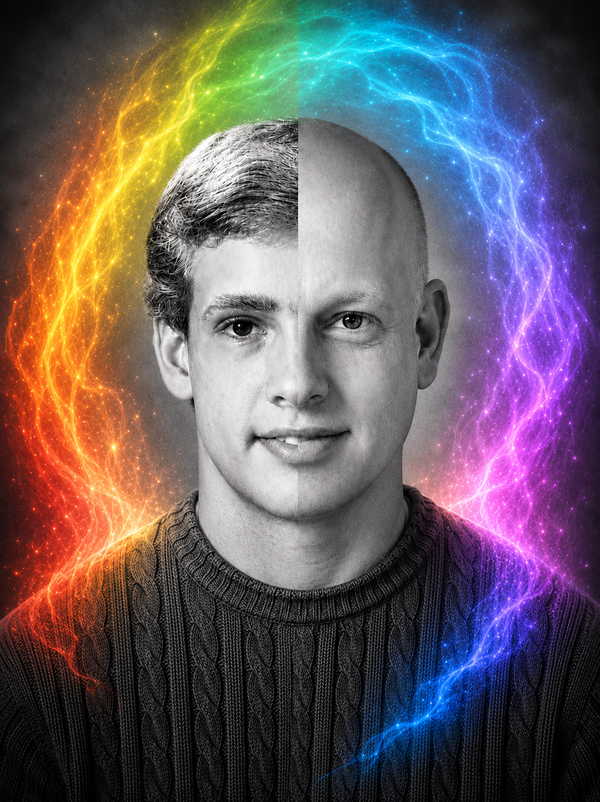
Read the poem again and notice that two different forces are at work in it, pulling in opposite directions.
One is the world doing the editing. The adults who change the words and then, with the words, the story. Hyperactive becomes Attention Deficit. Coffee becomes medication. The belt simply disappears from the record, because no one talks about it. A child insists he was left-handed and is told, calmly, that he was always right—that his own memory of his own body is a mistake. This is what the philosopher Miranda Fricker calls testimonial injustice: to be wronged specifically as a knower, to have your account of your own life weighed and found lighter than someone else's. Do it to a child often enough and you teach him a terrible lesson—that reality is not what happened, but whatever the room agrees to say happened.
Here is the connection I was slow to make, and it reorders everything. The common assumption is that ADHD impacts memory. That's true, but only partially, and my own experience has always been stranger than that. Yes, I have forgotten appointments, misplaced wallets, lost keys, walked into rooms and forgotten why I entered them. And at the same time I carry a long-term memory that has astonished people my whole life—childhood phone numbers, routes driven decades ago, lyrics, conversations, details everyone around me has long since dropped. The same people who marvel at that memory will, in the next breath, dismiss my account of what happened between us last week.
So the issue is not memory alone. It is credibility.
ADHD often creates real lapses; over time other people notice them, and a subtle shift occurs. They stop saying you might be mistaken and begin saying you're mistaken. The injury is not that we sometimes forget. The injury is being systematically positioned as a less reliable witness to our own lives. And to be told that your memory is wrong, your interpretation is wrong, your understanding is wrong, is not merely to have a fact corrected—it is to have the authority of your own experience challenged. Most people can absorb that without their grip on reality loosening. Many of us with ADHD cannot, because we already know our minds sometimes fail us. We know there are gaps. And because we know it, we are often the first to doubt ourselves—a hesitation other people can sense, and that some of them step into, supplying their version of events in the space where our certainty wavered.
Over years, that process does something worse than cost us confidence in a particular memory. It costs us confidence in our own testimony. We begin to wonder whether we are reliable witnesses to our own lives at all.
This is where the guardian enters. It protects not only against anxiety but against that constant background possibility of being wrong. When something becomes distressing enough, it does not help me face the thing; it edits my awareness around the thing. The bill stops feeling real. The appointment ceases to exist. The car keys vanish before the event I dread. The task does not merely become hard—it becomes invisible. I have come to call this apophylaxis: a guarding-away, a protection through disappearance. It is not laziness and not a failure of discipline; it is an ADHD mind regulating distress by reducing contact with the source of that stress. And because the guardian's horizon reaches no further than the present moment, it cannot tell the difference between safety now and flourishing at some future point. It knows only relief—peace bought now and billed, with interest, to a self who hasn't arrived yet.
None of this is meant to replace the clinical accounts. Executive dysfunction, emotional dysregulation, temporal discounting, rejection sensitivity—each describes, accurately, what happens. Apophylaxis is my word for what it feels like when those processes converge around something painful: the way the machinery, seen from outside as a set of deficits, registers from inside as a hidden intelligence quietly removing the painful thing from view. Same events, different vantage. The clinic describes the weather; I am trying to describe standing in it.
So the order of things is not that the family created this. ADHD was there first. The world shaped how it developed. Apophylaxis is one of the ways that development gets lived from the inside—and the editing the guardian performs on my own awareness has an unmistakable family resemblance to the editing once performed on me from the outside, by adults who changed the words and then the memories. The guardian found familiar tools in a world that often treated uncertainty as weakness and memory as guilt. It did not learn to exist. It learned where to look for danger.
But the guardian is not the only part. There is another force in the poem, the one that refuses. Something in me keeps track. Not bad. Not broken. Just watching. I think of this part as the archivist. Its job is to remember, to keep the record straight even when keeping it straight costs something, to hold onto I was there, and I know what I saw. The archivist is the reason the poem can be written at all. It is the part that did not get overwritten.
So the real life of this condition, for me, is not a fight against a deficit. It is a negotiation between these two parts. The guardian, who wants me safe and calm and undisturbed in the only moment it believes in. And the archivist, who wants me to remember, to finish the work, to face the envelope of my own life and open it. Neither is a villain. Both are trying to help. They simply worship different gods—one safety, the other reality—and most of my days are the argument between them.
The next poem is the guardian's. It is what the inside of the protection sounds like, and what it sounds like, in the end, is the archivist refusing to be the part that loses.
Second Brain
"My attention is not deficient — just divided."
I looked left. I looked right.
The car still hit me.
Not the car— the doubt that followed it.
My eyes obeyed.
The world arrived anyway from a direction I cannot name.
There is always a seam in the moment—
a place where memory loosens,
where a sentence drops a word,
where a thought goes missing mid-step—
and someone else steps into that space and speaks for me.
Gently, sometimes. Almost kindly.
No—this is what you meant.
No—this is what you did.
No—this is what happened.
I finished the paper.
I sat with it so many hours,
the finishing happened in my body without happening on the page.
The relief was real.
The relief was a lie.
The deadline passed,
and I learned that thinking about a thing
and doing a thing share the same nerve in me—
and the nerve misfires.
There is a second brain inside me.
Its only job is to keep the stress out of the room.
It will lie to me.
It will lose my keys so I do not have to leave.
It will tell me the assignment is next week.
It will tell me the boss said it was fine.
It will fill the missing word with whatever lets me sleep—
and in the morning the missing word is gone forever
and a stranger's word lives in its place.
They do not need to lie much.
They wait for the small holes in my certainty—
and there are always holes, oh love, there are always holes—
and slide their version in like a coin
into a slot machine that pays out in self-doubt.
You said that.
No I didn't.
You agreed to this.
Did I? You always do this.
And the second brain, which loves peace more than truth,
nods: yes, probably, sorry, sorry, sorry.
• • •
I have a checklist that is also a prayer.
Stove. Iron. Door. Dog. Stove. Iron. Door. Dog.
I am ten minutes late
and turning back to lay my hand on the doorknob
the way pilgrims touch a relic—
not to know,
but to be allowed to leave.
What if she gets out.
What if the road.
What if the alley.
What if she is afraid and I am not there.
I feel her fear in my ribs before anything has happened,
because my imagination is a cathedral with no off switch
and the saints inside are all my dog, all my dog, all my dog.
It is 10 p.m. and I will write one line.
It is 3 a.m. and the line has bred.
It is 6 a.m. and the room is cold.
The deadline that has waited for me all month has waited
because I built a small religion out of waiting,
because adrenaline is the only god
my body still remembers how to pray to,
because cortisol is the wafer on my tongue that lets me move at last—
and the body adapts,
and the god goes silent,
and one morning I open the envelope of my own life and say I can't.
I can't.
Never mind.
And a child inside me who looks like me weeps
the practiced weep of a child told by his own mouth that he is stupid,
that he is lazy,
that he should sit down,
that he should shut up,
that he should smoke the joint,
pour the drink,
walk to the gym and stay five hours,
walk to the park and stay until dinner,
spend the rent on a small clean table in the sun
where for forty minutes the second brain falls asleep
and I remember what my real one sounds like.
It sounds like this.
It sounds, surprisingly, like a poem.
It sounds like a man who looked left,
looked right,
was hit by the car—
and did not trust the road afterward—
and got up anyway,
and walked home,
and touched the door one more time—
The archivist has the last word
I said at the start that ADHD alters a person's relationship to memory, certainty, and self-trust, and that the attention problems are only its surface. By now I hope the shape of that claim is clearer. The deepest difficulty is not that I lose my keys. It is that losing my keys, missing the deadline, dropping the word mid-sentence, all accumulate into a case against my own testimony—a case the guardian then prosecutes from inside, editing my awareness to spare me the distress of it. Apophylaxis is one manifestation of that altered relationship. Not the whole of it, but the part I can feel working.
Notice where the guardian's poem ends. Not in the calm it spends its whole life chasing, but in the one act it can never perform on its own: a man getting up off the road, walking home, and touching the door one more time. That gesture belongs to the archivist. The guardian would have kept him down, safe and still and home. It is the other part—the one that keeps track, that remembers, that insists I was there—that gets him to his feet again.
I don't have a cure to offer at the end of this, and I'm suspicious of essays that produce one. Naming the guardian does not retire it. The keys still go missing. The bin still gets the bills some mornings. But there is a difference between being run by a process you cannot see and negotiating with one you can name, and that difference is most of what I have. When the second brain slides its coin into the slot and the room fills with probably they were right, probably you misremembered, probably it can wait—I can now, sometimes, hear the other voice underneath it. The quiet one. The one that has been keeping the record all along.
It says: I remember. I was there. My version belongs in the conversation too.
ADHD taught me that memory is fallible. Life taught me that other people's memories are fallible too. The task was never to decide who is always right—I'm not, and neither are they. The task is to stop surrendering my testimony simply because my memory is imperfect. I may forget. I may misremember. I may be wrong. But I am still a witness, and a witness who sometimes errs is not the same thing as no witness at all.
That voice was nearly edited out of me when I was small. The whole point of writing any of this down is that it wasn't.
The poems
The two poems in this essay, "Divided Opinions" and "Second Brain," are from the poetry collection Rainbows at the Gloaming, by Hugh S. Cooper.
Further Reading
- Charles Sanders Peirce, The Fixation of Belief (1877)
- Miranda Fricker, Epistemic Injustice: Power and the Ethics of Knowing (2007)
- Russell A. Barkley, Executive Functions: What They Are, How They Work, and Why They Evolved (2012)