The Scapegoat Comes Home
"Son, you are always with me, and all that is mine is yours."
— Luke 15:31 (RSV)
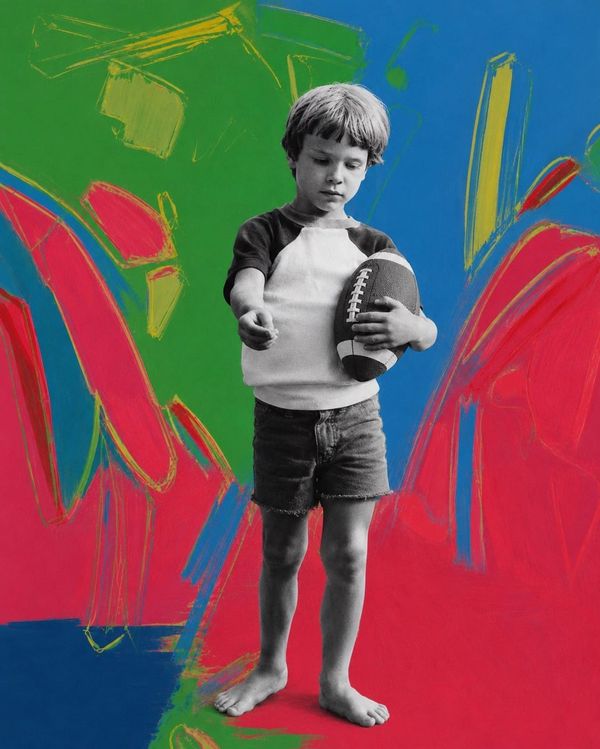
There is a peculiar burden carried by many children who grow up in troubled families. They come to believe that they are the problem.
Not because anyone necessarily says so outright. The message is usually more subtle than that. It arrives through glances, silences, corrections, disproportionate reactions, family stories, and the strange arithmetic by which one person's needs become everyone's explanation.
Over time, a child learns to ask a dangerous question: What if it really is me?
I know something about that question. For much of my life, I believed the difficulties around me had something to do with my existence. If conflict appeared, I searched myself. If relationships fractured, I searched myself. If tension filled a room, I searched myself. Long before I had language for family systems, neurodivergence, or scapegoating, I had already learned the reflex of self-examination. And the shame innate to my labelling could swing me from anger to depression.
This self-examination is hard and confusing, because the habit can look like humility. Sometimes it even masquerades as virtue. But often it is simply fear.
I have come to believe that no child breaks a house by needing love. Children arrive wanting warmth, steadiness, recognition, and safety. They come into the world reaching. Need is not pathology. Need is not failure. Need is not sin. To need is human.
Yet some houses carry weather inside them. Old storms move from room to room. Griefs remain unnamed. Expectations harden into laws no one remembers creating. Wounds pass quietly from one generation to the next until they seem part of the architecture itself.
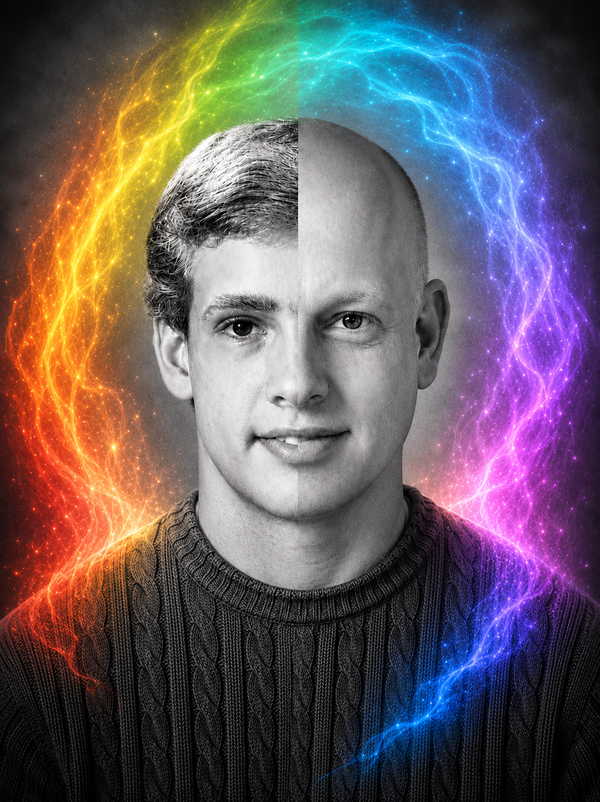
When the air grows thin, something must carry what cannot be spoken. Often it is the child who sees.
I have come to believe that scapegoating is not, at its root, an act of cruelty. Cruelty absolutely accompanies it, but the deeper mechanism is avoidance. Families, institutions, churches, and even nations place unbearable realities outside themselves. What cannot be faced within is cast outward. A burden seeks a body, a tribe, a gender, a sexuality, a race.
The French thinker René Girard spent his life describing this movement, and naming it gave me a strange relief—the relief of discovering that the thing done to so many has a shape, and that the shape is old. Girard argued that when tensions within a community become unbearable, conflict resolves itself into something deceptively peaceful: all against one. The group fixes upon a single figure who appears to embody its disorder, and in expelling that figure it experiences a temporary reconciliation.
The cruelest part of Girard's insight is what he observed about belief. For the mechanism to work, the participants cannot know they are doing it. They must sincerely believe the victim is guilty. To have a scapegoat is precisely not to know you have one.
This is why the scapegoat child is so often bewildered. The family does not experience itself as choosing a victim; it experiences itself as recognizing a problem. The accusation feels, to everyone making it, like simple perception.
The child who notices contradictions.
The child who asks questions.
The child who feels too much.
The child who does not fit.
The neurodivergent child.
The queer child.
The child who sees.
That child becomes the thing that is seen.
The process is ancient. We find it in religion, mythology, psychology, and history. Communities preserve themselves by locating disorder somewhere, in someone. Once identified, the carrier of that disorder appears to explain everything. The family wound suddenly has a name. The institution's failure suddenly has a face. The complexity of a system collapses into a person.
Relief arrives—but only for a while. Because the problem was never the child. It was the wound.
One of the hardest discoveries of adulthood is that shame arrives before understanding. Children feel rejection long before they can name the forces producing it. They feel different before they know why. They learn vigilance before they learn language. Experience comes first; thought follows after.
I have come to believe that thought begins not in logic but in feeling. Experience is encountered first as sensation, and only later becomes thought. What is most deeply known is not initially understood, but felt. Scapegoated children know this in the body. They feel the atmosphere before they understand the weather.
Years later, they acquire words: enmeshment, trauma, family systems, projection, neurodivergence, attachment, shame. But before any of those words existed, there was only feeling.
Something is wrong.
Someone is unhappy.
I must fix it.
I must become smaller.
I must become better.
I must become invisible.
Or, most painful of all: I must become someone else.
The miracle of adulthood is not that these beliefs disappear. The miracle is that they can be named. What is unnamed exerts influence without recognition. What is named enters into relationship. Naming does not undo the wound; it changes how the wound is held.
The moment we recognize that a burden was inherited rather than earned, something shifts. The story does not vanish. The pain does not evaporate. But the shame begins to loosen. The garment no longer fits as tightly. The weather no longer feels like identity.
Children begin to understand that clarity was never the crime. Seeing was not the trespass. Need was not the offense. The wound existed before their arrival; they merely became its mirror.
Forgiveness enters here reluctantly, and not because the wound is unreal. It enters reluctantly because the word has been worn smooth by misuse. To forgive is not to forget, and it is not the polite fiction that nothing happened, and it is certainly not a verdict that what happened was fine. It is something smaller and much harder than any of those: the refusal to let what was done to us decide what we do next.
The scapegoat mechanism keeps itself alive by repeating. The wounded make new wounds. The excluded learn the trick of exclusion. The accused, given enough years, become accusers. Forgiveness is where that inheritance can be set down instead of handed on—where you decline to be the next victim and, in the same motion, decline to make one. It does not pretend justice is unnecessary. It insists only that none of it is fated.
Growing up, then, is not learning to accuse. It is learning to distinguish—to separate what belongs to us from what does not, to keep our own responsibility without carrying everyone else's, to tell the truth without being consumed by it, to forgive without denying memory, to stay compassionate without surrendering reality.
This is harder than blame. Blame offers certainty. Attention asks more of us. It asks us to remain with complexity: to see that those who wounded us were often wounded themselves, to understand that inheritance is not the same as destiny, to recognize that what moves through families is not hunting for a culprit but searching for a form.
And here the question turns. It is one thing to climb down from the altar. It is another to decide what kind of person stands up afterward.
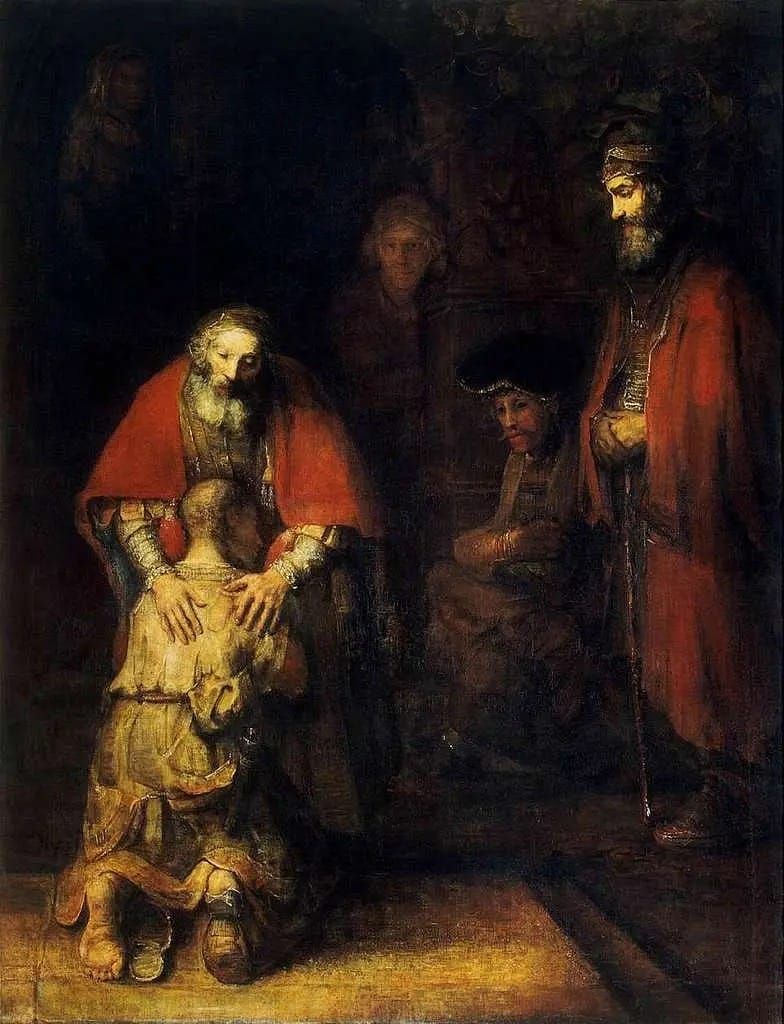
Henri Nouwen spent years contemplating Rembrandt's painting of the prodigal son. He saw himself first in the younger son who leaves and returns in shame, then in the elder son who remains and grows bitter in his obedience. But eventually he arrived at a more unsettling realization: "Though I am both the younger son and the elder son, I am not to remain them, but called to become the Father."
That sentence has haunted me. The summons is not only to come home but somehow to become home—to stop being the one who waits at the door to be let in and turn into the one who opens it. Not only to be welcomed back. To do the welcoming.
For scapegoated children, this asks something close to impossible. They have spent a lifetime as the accused. The grooves of their character run toward self-examination, self-doubt, self-erasure. They know how to stand at the edge of a room and read its atmosphere. They know how to make themselves small enough not to be the reason the evening goes wrong. They know how to carry things. What they do not know, at least at first, is how to set them down—and the painting Nouwen kept returning to shows exactly that gesture: a father's two hands resting on a kneeling back, not gripping, not correcting, simply holding.
Nouwen's challenge is not simply reconciliation but transformation: to become the kind of person who steps out of the mechanism altogether. Not to be expelled, and not, in revenge, to expel; not to win the old argument about who belonged, but to stop building belonging on the back of someone left outside.
This, I think, is the deeper meaning of coming home. Home is not the place where the wound began. It is the place where the wound stops setting the terms.
I find this almost unbearably difficult, and I want to be honest about that rather than tie it off too neatly. The reflex of self-examination does not retire quietly. The instinct to make oneself smaller does not vanish because one has read the right books. The old weather still returns. But the direction is clear, even when the progress is not.
Because the chain requires a link to stop. I cannot change what formed before my birth. I cannot rewrite history. I cannot rescue the child I was. But I can refuse to make another child carry what was given to me.
I can refuse to confuse difference with defect.
I can refuse to call honesty rebellion.
I can refuse to mistake sensitivity for weakness.
I can refuse to turn another human being into a vessel for what I will not face in myself.
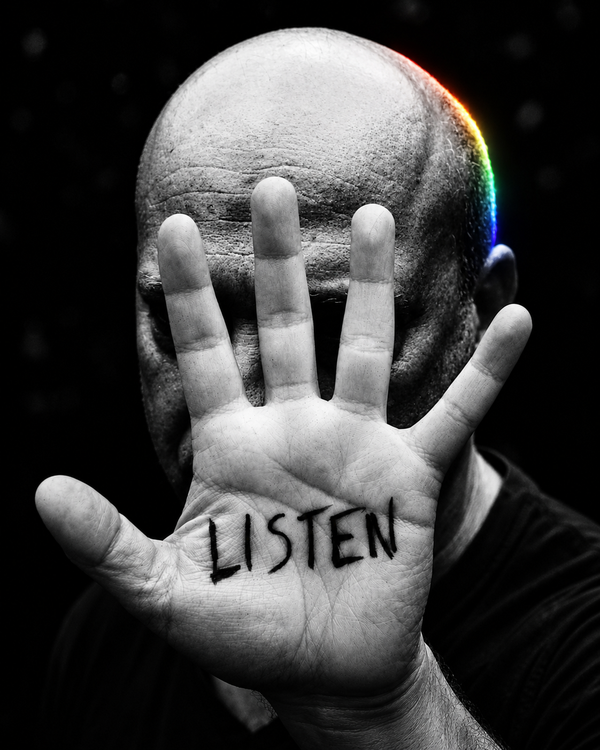
That, I think, is what it means for the scapegoat to come home. Not as vindication—nobody hands you a verdict—and not as victory, and not even as healing in the tidy sense the word usually carries. What you get instead is sight: the willingness to see the thing clearly and stay in the room with it, to name what is true, to say aloud what was kept quiet for years, and to let the burden stop here, in these hands, rather than travel on to someone smaller.
At the last, understanding is knowing that the child who saw too much was never the problem—only the first one willing to look. And eventually, the first one willing to speak. And perhaps the one who had belonged all along—even when belonging was not safe.
Further Reading
- Henri J. M. Nouwen, The Return of the Prodigal Son: A Story of Homecoming (1992)
- René Girard, The Scapegoat (1986)
- René Girard, Violence and the Sacred (1972)
- The Holy Bible, Revised Standard Version (Luke 15:11–32, the Parable of the Prodigal Son)